27/07/2026
Solutions to Enhance Economic Resilience for Vietnam’s Development in the New Context
Ho Chi Minh City, July 22, 2026 – The national scientific conference entitled "Solutions to Enhance Economic Resilience for Vietnam’s Development in the New Context" was jointly organized by the Vietnam Institute of Economics and World Economy (IVAWE) and the University of Economics and Law (UEL), Vietnam National University Ho Chi Minh City, on 22 July 2026 in Ho Chi Minh City. The conference was conducted as part of the national research project "Solutions to Enhance Economic Resilience for Vietnam’s Development in the New Context", under the National Key Science and Technology Program KX.01/21–30. It attracted broad participation from scholars, experts, university lecturers, policymakers, and representatives of the business community from across the country.
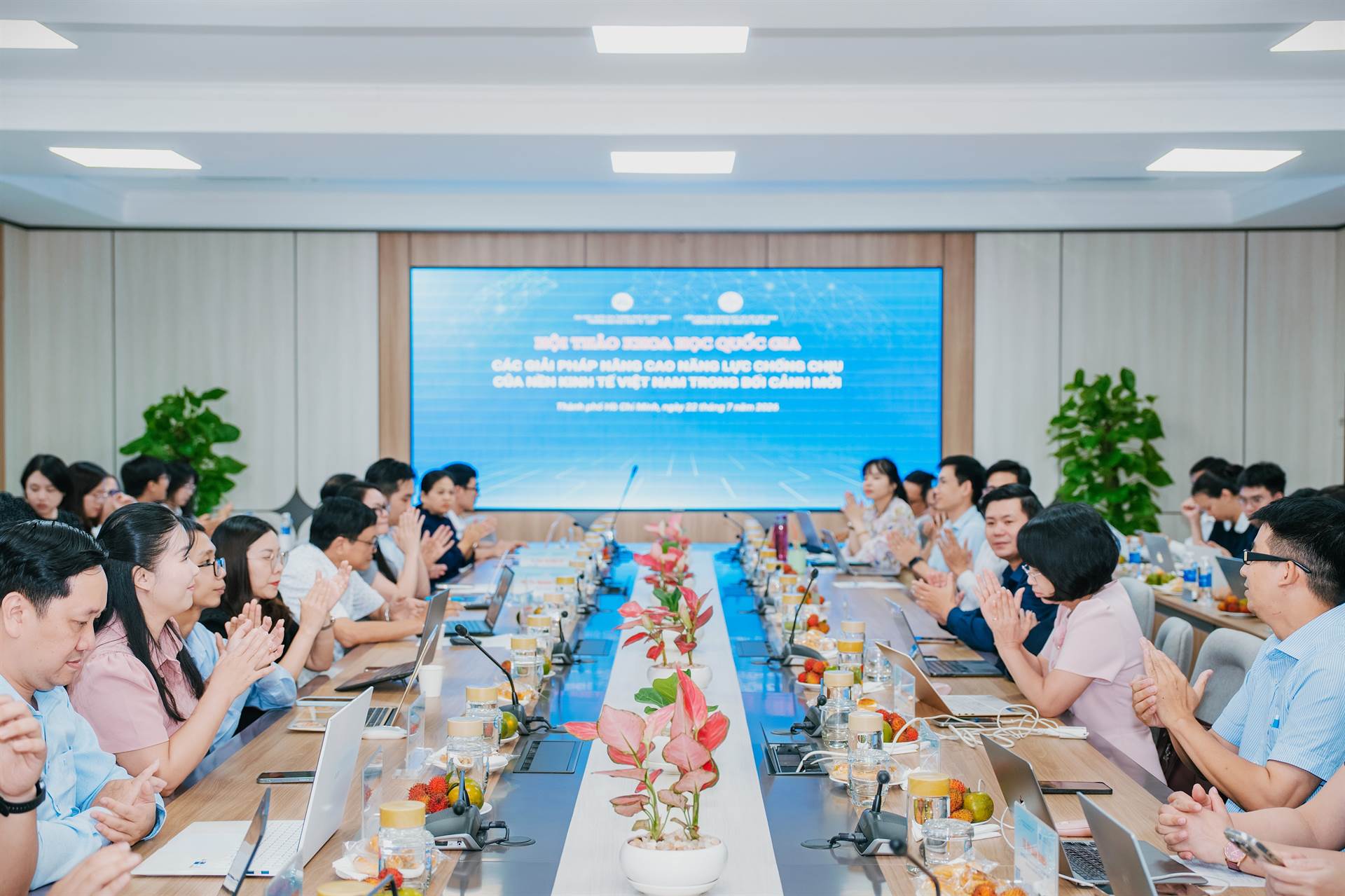
Solutions to Enhance Economic Resilience for Vietnam’s Development in the New Context
The national scientific conference entitled "Solutions to Enhance Economic Resilience for Vietnam’s Development in the New Context" was jointly organized by the Vietnam Institute of Economics and World Economy (IVAWE) and the University of Economics and Law (UEL), Vietnam National University Ho Chi Minh City, on 22 July 2026 in Ho Chi Minh City. The conference was conducted as part of the national research project "Solutions to Enhance Economic Resilience for Vietnam’s Development in the New Context", under the National Key Science and Technology Program KX.01/21–30. It attracted broad participation from scholars, experts, university lecturers, policymakers, and representatives of the business community from across the country.
The conference was co-chaired by Dr. Tran Thanh Long, Vice Rector of the University of Economics and Law; Associate Professor Dr. Nguyen Tien Dung, former Rector of the University of Economics and Law and Editor-in-Chief of the VNUHCM Journal of Economics, Business and Law; and Dr. Le Xuan Sang, Deputy Director of the Vietnam Institute of Economics and World Economy and Project Leader of the national research project. Participants included representatives of the Steering Committee of the KX.01/21–30 Program, researchers from leading research institutes and universities, officials from government agencies, professional associations, and business organizations. Nearly 50 peer-reviewed papers were selected for inclusion in the conference proceedings, reflecting diverse and innovative perspectives on strengthening the resilience of Vietnam's economy amid an increasingly volatile and uncertain global economic environment.
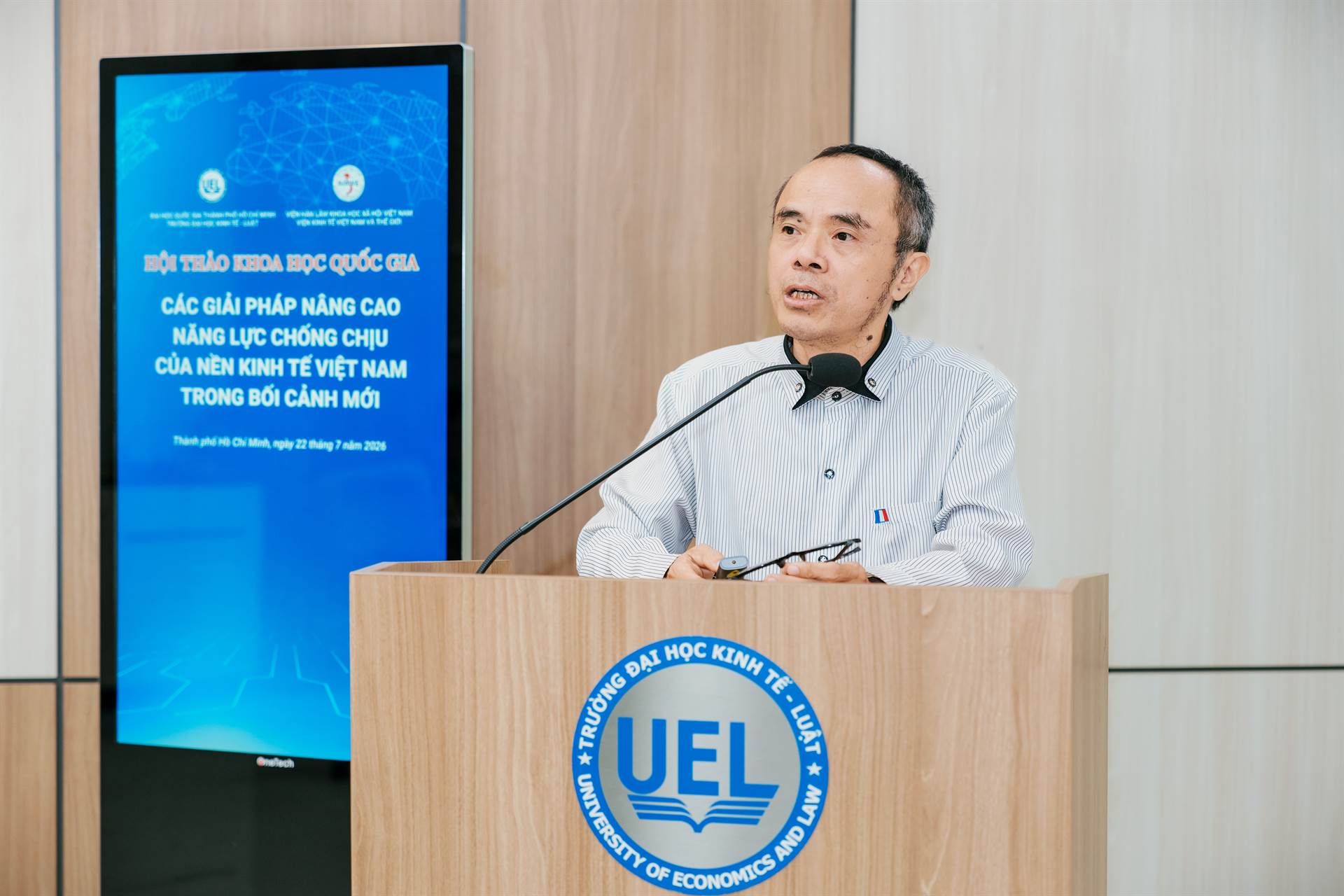 Dr. Le Xuan Sang presented the introductory report at the conference.
In their opening remarks, leaders of the University of Economics and Law and the Vietnam Institute of Economics and World Economy emphasized that the world is currently facing overlapping economic, financial, geopolitical, and climate-related shocks, alongside rapid digital transformation and the advancement of artificial intelligence. Against this backdrop, enhancing national economic resilience has become a strategic priority for every country. For Vietnam—an economy characterized by a high degree of openness and deep international integration—developing a solid scientific foundation for policies that strengthen economic resilience is not only academically significant but also directly relevant to policymaking in the country's new stage of development.
In the keynote report, Dr. Le Xuan Sang, Vice President of the Vietnam Institute of Economics and World Economy and project leader, presented the overall research framework and the project's preliminary findings. The report conceptualizes economic resilience through four core capacities: absorption, adaptation, recovery, and transformation. It further proposes five major analytical pillars: financial security; economic strength; economic structure; science, technology and innovation; and the quality of institutions, national governance, social capital, and human capital. This framework represents one of the most comprehensive approaches currently proposed for assessing Vietnam's economic resilience in the face of increasingly complex global risks.
.jpg) Workshop participants
Workshop participants
A notable feature of the report was the introduction of the proposed Vietnam Resilience Index, which aims to quantify the resilience of the national economy using internationally comparable indicators. According to the research team, developing a comprehensive resilience index will not only facilitate the assessment of the current state of the economy but also provide a scientific basis for monitoring, forecasting, and designing policies that enhance the country's capacity to withstand future shocks.
During the following sessions, scholars from leading universities and research institutes across Vietnam examined the topic from a wide range of perspectives. Despite their diverse approaches, participants broadly agreed that economic resilience is determined not only by macroeconomic fundamentals but also increasingly by the quality of institutions, innovation capability, scientific and technological development, the autonomy and competitiveness of enterprises, and the adaptability of the financial system to changes in the international environment.